A book by Manuel Kilian
How Nations Digitise is the definitive guide to digital statecraft, the ability to turn technology into governing capacity.

Press and Praise
From the foreword
“I would urge you to read it as a manual for those who intend to govern and as a warning for those who assume they still can.”
“Finally, a book on digitisation of the state, that is, public services, governance and administration, that gets it right, and looks at a number of countries and approaches to figure out what works and what does not. There is no one-size-fits-all approach to digitisation, but the reader can glean from the book which approaches are best for a particular country to follow – and avoid.”
“Serving both California, the world’s fourth largest economy and home to Silicon Valley, and Montenegro, a country of half a million people, taught me that scale, proximity to technology and money alone do not solve the riddle of digital government. The obstacles run deeper, and finally there is a book that names them systematically and can serve as a compass for change.”
“Digital transformation of government is as much a leadership challenge as a technical one, if not more so. Done right, it will boost a country’s competitiveness, international prestige and citizens’ trust in its institutions. Kilian sets out the playbook for success in this must-read for digital leaders and prime ministers alike. I only wish it had been on my desk when I became Slovenia’s first digital minister in 2021.”
The puzzle of governments going digital – or failing to
Brazil. Estonia. India. Ukraine. Singapore. Rwanda. The United Arab Emirates.
All seven have made remarkable progress in digital government, despite major differences in their political systems, geography, wealth and technological capabilities.
Why were they able to produce results where others were not? This is the question I could not let go.
So I took the question to the ministers, chief information officers and reformers driving digital government around the globe. After two years of conversations, my answer is that money and technology matter, but they are not what separates the leaders from the laggards. It is digital statecraft.
The question matters more than it sounds, because what is at stake is the social contract itself, the centuries-old bargain in which citizens grant the state authority and in return expect it to deliver. When an online public service stalls, it is more than an IT glitch. It is a small tear in that bargain.
How Nations Digitise is the first book to answer that question in full. It defines digital statecraft as the art of governing, reforming, building and delivering in the digital age, and sets out the ten forces that decide which states have it.
The ten forces of digital statecraft
The traditional disciplines of statecraft have always had their canons. Diplomacy, military strategy and economic policy each developed a body of thought over centuries.
Digital has none yet: governments improvise, and the few that succeed have done so as much through design as through accident or luck.
How Nations Digitise supplies what is missing, structuring digital statecraft across ten forces in three groups: foundations, setting the political preconditions for everything; capacity, the institutional muscle a state needs before it can deliver; execution, whether what is built reaches its objectives or fails along the way.
-
Foundations
01
Having agency
on being willing and able
Most digital government failures are decided long before a single line of code is written. Agency is the capacity to set a digital trajectory and hold it, and it requires both the willingness to drive change and the ability to know what that change demands. A government with one but not the other produces announcements rather than progress.
-
Foundations
02
Creating urgency
on building and maintaining momentum
Digital transformation rarely has a natural deadline, which is why it keeps becoming next week's problem. Without urgency, even a willing government produces little more than strategy documents. This is the force that pulls the work up the pile and pins it there.
-
Foundations
03
Engineering permanence
lock-in across time and turf
Leaders move on, and the ministry next door ignores what they built. Permanence is the legal, organisational, coalitional, behavioural and technical machinery that makes reversal costly. Urgency keeps people pushing; permanence makes the results outlast the people who built them.
-
Capacity
04
Building features, not monuments
how to think and act in iterations
The instinct to plan exhaustively, specify completely and unveil triumphantly works for museums and stadiums. It does not work for software, which is never finished but shaped continuously by users, policy and technology. Governments that skip the messy pilot meet their users for the first time on national launch day.
-
Capacity
05
Confronting legacy
on managing technical and bureaucratic debt
Not all debt is denominated in euros. Some of the heaviest burdens governments carry sit in decades-old code that nobody fully understands, and in layers of rules and procedures that nobody dares touch. The two grow into each other over time, which is why clearing one without the other rarely works.
-
Capacity
06
Escaping the procurement black hole
how to buy well
Systems designed to guarantee fairness and value end up stifling innovation. Path dependency, organisational inertia, overspecification and outdated process together trap good intentions and quietly decide what a government is able to buy. More digital initiatives die here than in any technical failure.
-
Capacity
07
Overcoming culture
why knowing better is simply not enough
The evidence on monumental projects, legacy systems and broken procurement is not ambiguous. Public organisations default to approaches they know do not work because deeper cultural reflexes hold those approaches in place. This force is about the gravitational pull of conformity and the seduction of procedure, and what it takes to break both.
-
Execution
08
Putting the user first
on designing for experience, not bureaucracy
Why can you order a pizza with three taps while renewing a passport still feels like decoding ancient administrative scrolls? Governments routinely design services around their own organisational logic rather than around the people who have to use them. When they design for people instead, they earn trust.
-
Execution
09
Optimising for adoption
why building is only half the job
The institutional vocabulary of government includes build, procure and deploy. It does not include market, distribute or activate. Adoption is the one metric that shows whether a service is creating value, and governments that build and hope for the best rarely get it.
-
Execution
10
Setting boundaries
what to own, where to govern, when to let go
Every government must answer three questions about any piece of technology it touches: should we own it, govern it or let it go? The questions are simple. The answers are not, and no formula produces them.
Written from inside the room

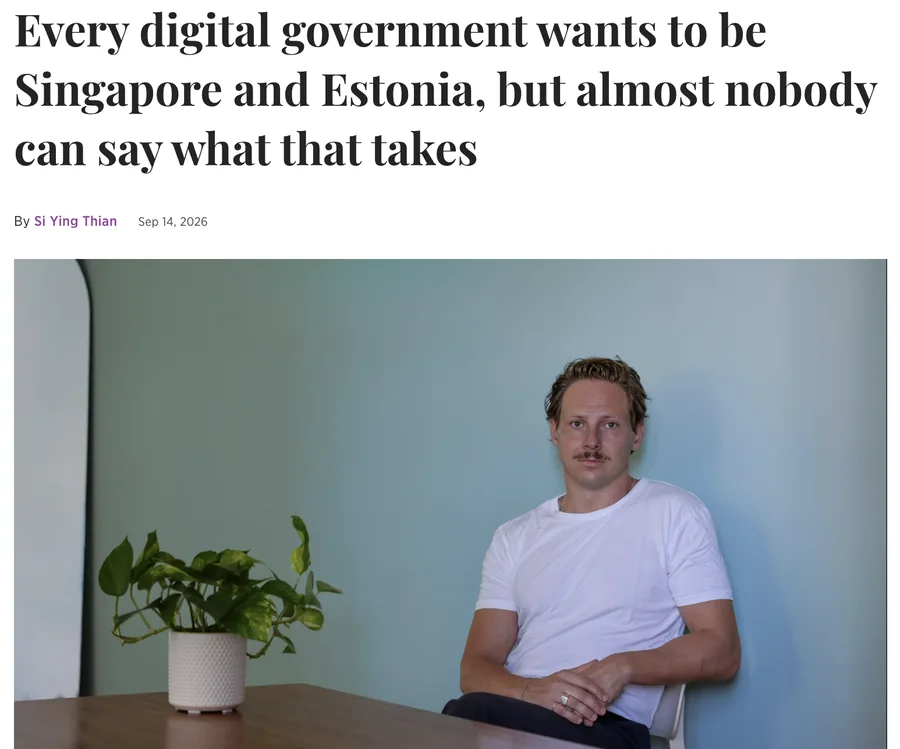
I have spent over a decade at the intersection of government and technology, and I have seen it through four different lenses:
Through ministerial eyes. I advise Germany's Federal Ministry for Digital Transformation and Government Modernisation, and governments abroad on agentic AI, including the Prime Minister's Office of the United Arab Emirates. This is where I see how far political will travels before it meets the machinery that has to deliver it.
As the head of an international organisation. I was founding managing director of the Global Government Technology Centre in Berlin, a collaboration between the World Economic Forum and governments around the world, which put me in the room with digital leaders facing the same problems and solving them in very different ways.
As an entrepreneur. I built and sold the technology company GovMind, one of Europe's leading procurement intelligence platforms for the public sector, which taught me how governments buy and why so much good technology never reaches them.
As a researcher. I hold an MPhil in Public Policy from the University of Cambridge, focused on technology, which gave me the analytical grounding for everything that followed.
Why you should read it
Accessible enough for an executive looking for management advice, rigorous enough for the seminar room, How Nations Digitise works for very different readers. If you are…
A policymaker or a public-sector leader, it makes the hidden forces of digital transformation evident to you, so that you know what to push for, and why things may not be working the way you want them to.
A researcher or a student, it finally brings together in one book the theories from a whole set of disciplines, the analytical knowledge and the case studies you need to understand digital transformation in government.
A GovTech entrepreneur, it is your guide to why and how to sell into the public sector, and to why it is so often about everything except the product itself.
An engaged citizen, it gives you a blueprint to hold against your own government, so that you can judge whether it is meeting its side of the social contract, and if not, why.
Get the book
- Imprint
- Anthem Press
- Publication date
- 30 November 2026
- Extent
- 200 pages
- ISBN
- 9781801361972
- Paperback
- £19.99 / $24.95
- Hardback
- £80.00 / $120.00
- eBook (WEB PDF and EPUB)
- £19.99 / $24.95
Review copies, rights, course adoption and bulk orders via Anthem Press.
Preorder